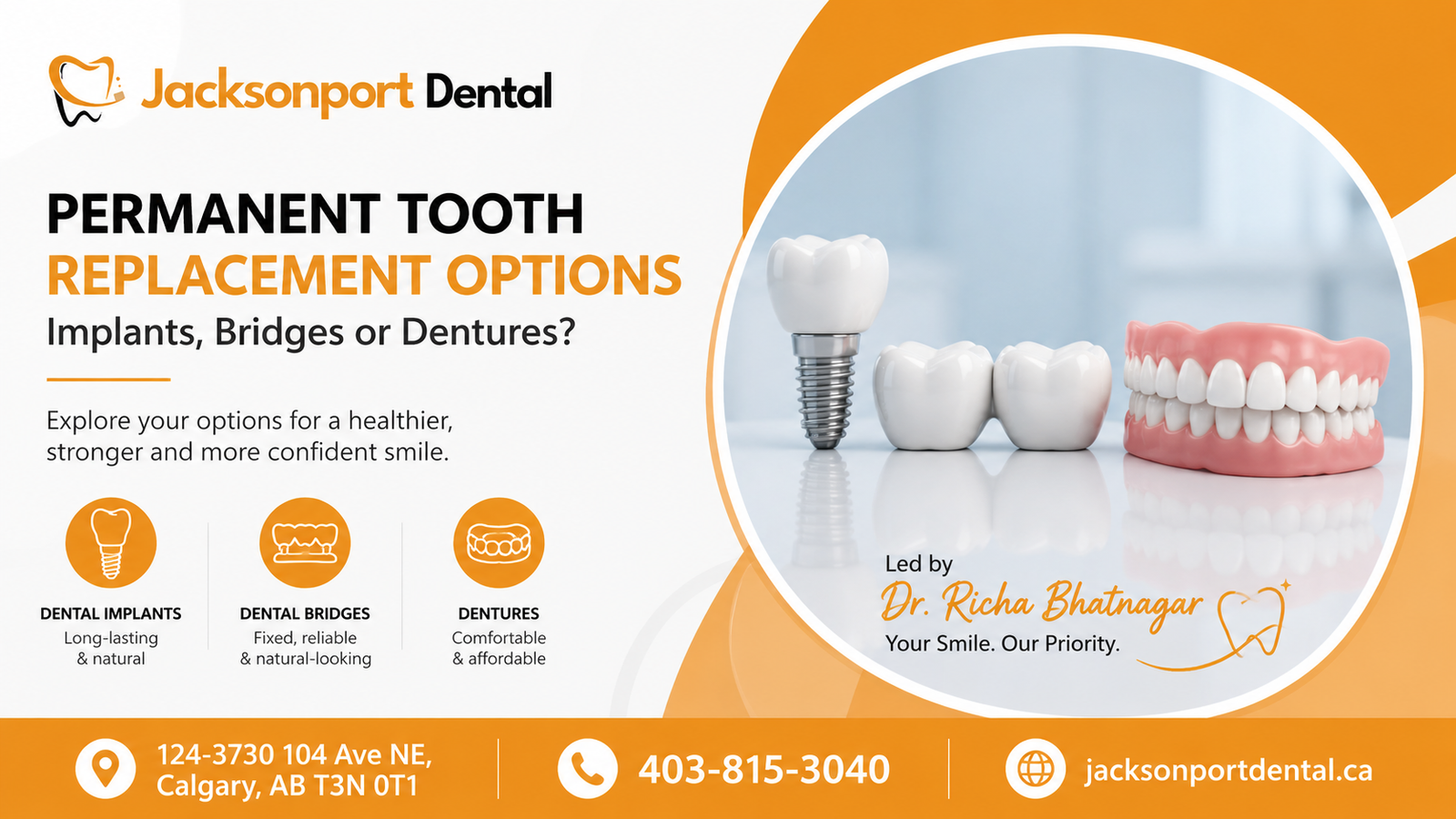
If you’re considering permanent tooth replacement, our team at Jacksonport Dental can help determine whether dental implants, dental bridges, or dentures are the right solution for your smile.
One of the most common questions patients ask is:
“What is the best permanent tooth replacement?”
The answer depends on several factors, including your oral health, budget, number of missing teeth, jawbone condition, and long-term goals.
Fortunately, modern dentistry offers several highly effective options for replacing missing teeth. The three most common solutions are:
- Dental implants
- Dental bridges
- Dentures
Each option has advantages and limitations.
In this guide, Dr. Richa Bhatnagar and the team at Jacksonport Dental explain the differences between implants, bridges, and dentures so Calgary patients can make informed decisions about their oral health.
What Is the Best Permanent Tooth Replacement?
Featured Snippet Answer
For most patients, dental implants are considered the best permanent tooth replacement because they replace both the tooth root and crown, preserve jawbone health, provide exceptional stability, and can last for decades with proper care. However, bridges and dentures may be more appropriate depending on the number of missing teeth, oral health condition, and budget.
Why Replacing a Missing Tooth Matters
Many people assume that losing one tooth isn’t a major problem.
Unfortunately, even a single missing tooth can create long-term complications.
When a tooth is lost:
- Adjacent teeth may shift
- Bite alignment can change
- Chewing becomes less efficient
- Speech may be affected
- Jawbone deterioration can begin
- Facial support can gradually decrease
The longer a tooth remains missing, the greater the chance of additional dental problems developing.
Learn more about maintaining oral health: The Vital Link Between Oral Health and Overall Well-Being
Understanding Your Tooth Replacement Options
Today’s dentistry offers three primary solutions:
- Option 1: Dental Implants
- Option 2: Dental Bridges
- Option 3: Dentures
Let’s explore each in detail.
Dental Implants: The Gold Standard for Permanent Tooth Replacement
Dental implants are often considered the closest replacement to a natural tooth.
A dental implant consists of:
- A titanium implant post
- An abutment
- A custom dental crown
The implant is surgically placed into the jawbone where it functions like an artificial tooth root. Over time, the implant integrates with the bone through a process called osseointegration.
Once healed, a custom crown is attached to complete the restoration.
Advantages of Dental Implants
Natural Appearance
Implants closely resemble natural teeth in both appearance and function.
Bone Preservation
Unlike bridges and traditional dentures, implants stimulate the jawbone and help prevent bone loss following tooth loss.
Long-Term Durability
With proper care, dental implants can often last decades.
No Impact on Adjacent Teeth
Healthy neighboring teeth remain untouched.
Excellent Chewing Function
Patients can generally eat, chew, and speak normally.
Potential Limitations of Dental Implants
Implants may not be ideal for everyone.
Potential considerations include:
- Higher initial investment
- Surgical procedure required
- Healing period required
- Adequate bone support needed
- Additional procedures such as bone grafting may be necessary
Learn more: The Truth About Dental Implants: Process, Cost and Benefits
Who Is a Good Candidate for Dental Implants?
You may be a candidate if you:
- Are missing one or more teeth
- Have healthy gums
- Have sufficient jawbone support
- Do not smoke heavily
- Are committed to maintaining oral hygiene
A consultation and imaging assessment can help determine eligibility.
Dental Bridges: A Fixed Tooth Replacement Solution
A dental bridge literally “bridges” the gap left by a missing tooth.
The restoration consists of:
- Artificial replacement tooth (pontic)
- Supporting crowns on adjacent teeth
Bridges have been successfully used for decades and remain a popular treatment option.
Advantages of Dental Bridges
Fixed Restoration
Unlike removable dentures, bridges remain in place.
Faster Treatment
Treatment is often completed faster than implant therapy.
No Surgery Required
Patients who wish to avoid surgery may prefer bridges.
Natural Appearance
Modern bridges can provide highly aesthetic results.
Potential Limitations of Dental Bridges
- Healthy Teeth Must Be Modified
- Traditional bridges often require removing enamel from neighboring healthy teeth.
- No Jawbone Stimulation
- Because the root is not replaced, bone loss may continue beneath the missing tooth area.
- Lifespan Considerations
- Bridges generally require replacement sooner than implants.
Learn more about treatment options: Crowns, Bridges and Veneers
Need Help Choosing the Right Tooth Replacement Option?
Every smile is different. Dr. Richa Bhatnagar can evaluate your oral health, jawbone condition, and long-term goals to recommend the most suitable treatment.
Dentures: Replacing Multiple Missing Teeth
Dentures remain a valuable solution for patients missing several or all teeth.
Modern dentures are far more comfortable and natural-looking than many people realize.
There are several types:
Full Dentures
Replace all teeth in an upper or lower arch.
Partial Dentures
Replace several missing teeth while retaining natural teeth.
Implant-Supported Dentures
Combine dentures with implants for improved stability.
Advantages of Dentures
Cost-Effective
Traditional dentures are often the most affordable tooth replacement option.
Replace Multiple Teeth
Ideal for extensive tooth loss.
Non-Surgical Option
Many denture solutions require no surgery.
Improved Appearance
Restore facial support and smile aesthetics.
Potential Limitations of Dentures
Movement
Traditional dentures may shift during eating or speaking.
Bone Loss Continues
The jawbone may continue shrinking over time.
Periodic Adjustments
Relines and replacements may be needed.
Reduced Bite Force
Chewing efficiency is often lower than implants.
Learn more about modern denture options: Dentures at Jacksonport Dental.
Comparing Implants vs Bridges vs Dentures
| Feature | Dental Implants | Bridges | Dentures |
|---|---|---|---|
| Permanent Solution | Yes | Yes | No |
| Replaces Tooth Root | Yes | No | No |
| Bone Preservation | Excellent | Limited | Limited |
| Surgery Required | Yes | No | Usually No |
| Stability | Excellent | Excellent | Moderate |
| Longevity | Highest | Moderate | Moderate |
| Maintenance | Low | Moderate | Higher |
| Cost | Highest Initial | Moderate | Lowest Initial |
What About Implant-Supported Dentures?
Many Calgary patients today choose implant-supported dentures.
This solution combines:
- Stability of implants
- Affordability of dentures
- Improved chewing function
- Better comfort
For patients missing many teeth, implant-supported dentures can offer a significant improvement compared to traditional removable dentures.
If you’re considering implant-supported restorations, learn more about Dental Implants and Dentures.
What Happens If a Tooth Needs Extraction First?
Many patients require extraction before replacement treatment begins.
Common reasons include:
- Severe decay
- Fractured teeth
- Advanced gum disease
- Failed root canal treatment
- Wisdom tooth complications
After extraction, your dentist will discuss the most appropriate replacement timeline.
You may also find these resources helpful:
Long-Term Value vs Initial Cost
One mistake many patients make is evaluating treatment solely by initial cost.
Instead, consider:
- Longevity
- Maintenance costs
- Future repairs
- Comfort
- Oral health benefits
- Quality of life improvements
Although implants typically involve a higher upfront investment, many patients find they provide excellent long-term value because of their durability and bone-preserving benefits.
Why Calgary Patients Often Choose Dental Implants
At Jacksonport Dental, many patients seeking permanent tooth replacement choose implants because they:
- Feel closest to natural teeth
- Help preserve jawbone
- Support long-term oral health
- Provide exceptional stability
- Allow normal eating and speaking
However, every patient is unique.
The best solution depends on your clinical needs and goals.
Read more: Dental Implants Solution and How to Care for Your Dental Implants.
Missing a Tooth? Explore Your Best Replacement Option Today
Whether you’re considering implants, bridges, or dentures, our team can help you understand the advantages, costs, and long-term benefits of each treatment option.
Serving Patients Throughout NE Calgary
Our team proudly helps patients from:
Whether you’re replacing a single missing tooth or exploring full-mouth restoration options, we’re here to help you understand every available treatment.
Final Thoughts
Missing teeth affect much more than appearance.
They can influence chewing, speech, confidence, facial structure, and long-term oral health.
Fortunately, modern dentistry provides excellent solutions.
Dental implants, bridges, and dentures each offer unique benefits.
For many patients, dental implants remain the most effective permanent tooth replacement option because they provide stability, preserve bone, and closely mimic natural teeth. However, bridges and dentures continue to be excellent choices in the right circumstances.
The best way to determine which option is right for you is through a personalized dental consultation.
Frequently Asked Questions About Permanent Tooth Replacement
What is the best permanent tooth replacement?
For many patients, dental implants are considered the best permanent tooth replacement because they replace the tooth root, preserve bone, and offer excellent long-term durability.
Are dental implants permanent?
Dental implants are designed to be a long-term solution and can often last decades with proper care.
Is a bridge better than an implant?
It depends on your oral health, bone support, and treatment goals. Implants preserve bone, while bridges may offer faster treatment.
Are dentures considered permanent tooth replacement?
Traditional dentures are removable and are generally not considered permanent. Implant-supported dentures provide greater long-term stability.
How much does it cost to replace a missing tooth in Calgary?
Costs vary depending on the treatment selected, complexity, and whether additional procedures are required.
Can I get an implant immediately after an extraction?
In some cases yes, but suitability depends on bone quality, infection status, and overall oral health.
What happens if I don’t replace a missing tooth?
Neighboring teeth may shift, bone loss can occur, and chewing function may be affected.
How long do dental bridges last?
Many bridges last 10 years or longer with proper care and maintenance.
Ready to Restore Your Smile?
Schedule a consultation with Dr. Richa Bhatnagar and the Jacksonport Dental team to discuss dental implants, bridges, dentures, and other tooth replacement options.