
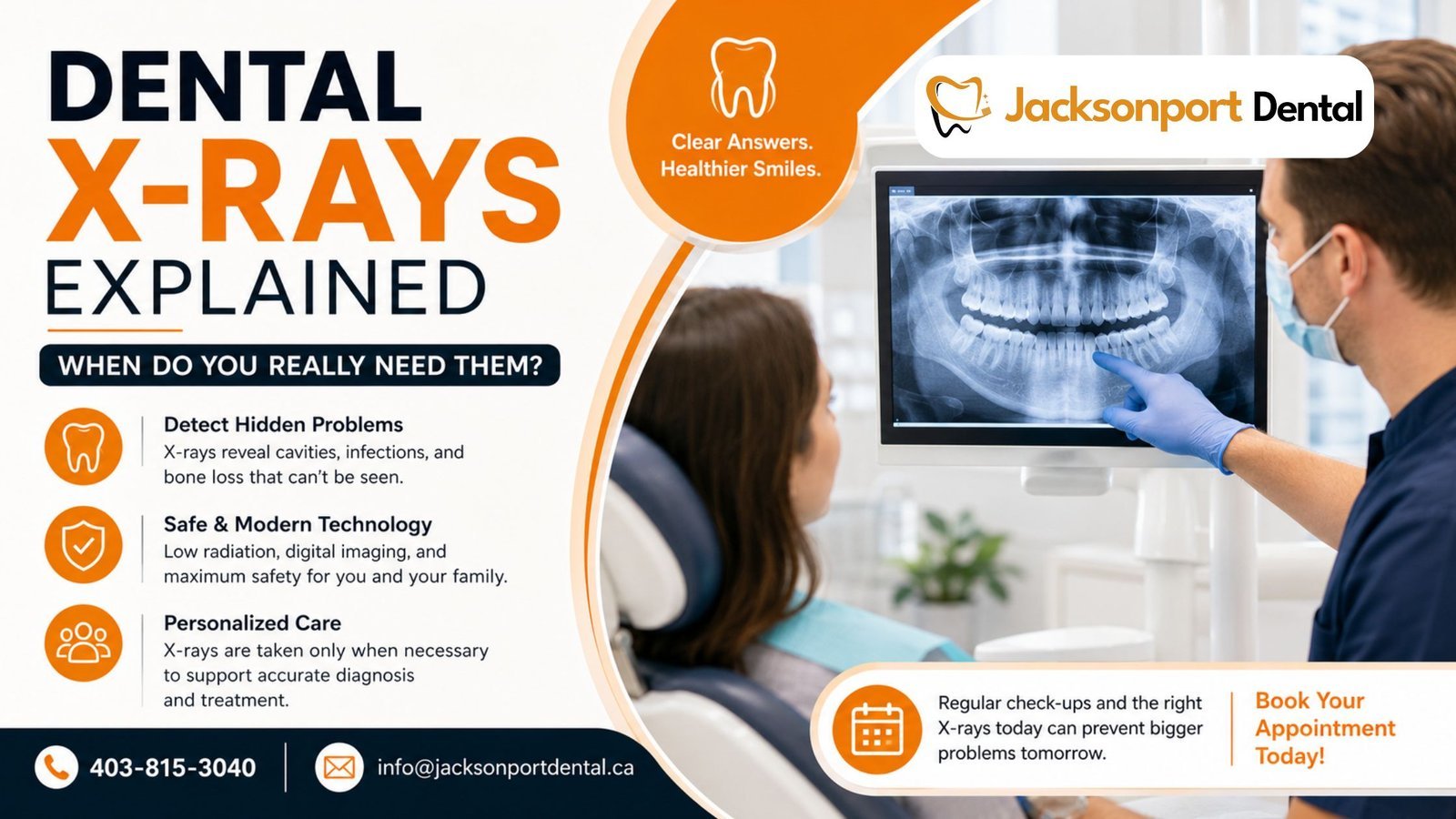
If your dentist recommends dental X-rays, you may wonder, “Do I really need another X-ray?” It is a common question, especially when your teeth feel fine and look healthy.
The important thing to understand is that a dental examination can only reveal what is visible. X-rays allow your dentist to see areas that may be hidden beneath the gums, between teeth, or inside the jawbone.
For patients looking for dental X-rays in Calgary, understanding why these images are recommended can make your next dental visit much less confusing.
Why Do Dentists Take X-Rays?
Dentists take X-rays to identify dental problems that may not be visible during a regular oral examination and to help plan appropriate treatment.
Dental X-rays can help identify:
- Cavities between teeth
- Tooth decay beneath existing fillings or crowns
- Bone loss associated with gum disease
- Problems around tooth roots
- Impacted or developing teeth
- Dental infections and abscesses
- Cysts or other abnormalities
- Wisdom tooth positioning
- Bone and jaw conditions
- The underlying position of teeth before certain treatments
This does not mean every patient needs the same X-rays at every visit. Dental imaging should be based on the patient’s individual clinical needs rather than a fixed schedule.
A comprehensive dental examination can help your dentist determine whether additional imaging is appropriate for your oral health.
When Do You Really Need Dental X-Rays?
There is no universal answer to how often someone should have dental X-rays. Your dentist considers several factors before recommending imaging.
These may include:
- Your age
- Your current oral health
- Your history of cavities or gum disease
- Any current symptoms
- Your risk of developing dental disease
- Previous X-rays and available dental records
- The type of dental treatment being considered
For example, someone with a history of frequent cavities may need imaging more often than someone with consistently healthy teeth and a low risk of dental disease.
If you recently had dental X-rays at another dental office, tell your dentist. Previous images may provide useful information and can help avoid unnecessary repeat imaging when appropriate.
What Can Dental X-Rays Find That a Dentist Can’t See?
Think of an X-ray as giving your dentist a view beneath the surface.
During a visual examination, your dentist can inspect your teeth, gums and other visible structures. However, some dental problems develop in places that cannot be fully examined simply by looking.
For example, an X-ray may reveal decay developing between two teeth, changes around a tooth root, or bone loss that is not obvious during a routine examination.
This can be particularly useful when you have symptoms such as:
- Persistent tooth pain
- Swelling
- Unexplained sensitivity
- Pain when biting
- A damaged or fractured tooth
- A suspected infection
- Changes in your bite
- A history of extensive dental treatment
In these situations, an X-ray may help the dentist understand what is happening and determine the most appropriate next step.
Are Dental X-Rays Safe?
For most patients, the radiation dose from an individual dental X-ray is very low, and dental X-rays are considered safe when they are clinically appropriate.
That does not mean X-rays should be taken unnecessarily. Your dentist should recommend imaging when the information it provides can help with diagnosis, monitoring, or treatment planning.
Modern dental imaging focuses on keeping radiation exposure as low as reasonably achievable while obtaining the diagnostic information needed.
Dentists can help minimize unnecessary exposure by:
- Selecting the appropriate type of X-ray
- Limiting the area being examined
- Using appropriate digital imaging technology
- Avoiding unnecessary repeat images
- Reviewing previous dental images when they are available and clinically suitable
If you are concerned about dental X-ray safety, talk with your dentist before the procedure. Your dental team can explain why the image is recommended and what information they expect it to provide.
Do Children Need Dental X-Rays?
Children may need dental X-rays in certain situations, but imaging should be individualized rather than automatically performed on every child.
X-rays can be useful for monitoring developing teeth, evaluating areas that cannot be adequately examined during a visual examination, or investigating suspected dental problems.
Because children are still developing, dentists take particular care to ensure that imaging is clinically justified and that the exposure is appropriately optimized.
Parents should feel comfortable asking:
“What are you looking for with this X-ray?”
A good dental team should be able to explain the reason for recommended imaging in clear, understandable language.
For families in NE Calgary, Jacksonport Dental also provides children’s dental services designed around the individual needs of growing smiles.
Do You Need X-Rays at Every Dental Checkup?
Not necessarily.
There is no one-size-fits-all schedule for dental X-rays. The appropriate frequency depends on your individual dental health, age, disease risk, symptoms and previous dental history.
Someone with a history of cavities or other dental problems may require imaging more frequently than a patient with consistently healthy teeth and a low risk of dental disease.
If you recently had X-rays at another dental office, let your dentist know. Your previous records may help your dental team decide whether new images are actually needed.
This is one reason keeping your dental records organized can be helpful when changing dentists or moving to a new dental clinic in Calgary.
What Types of Dental X-Rays Are Used?
Different types of dental X-rays provide different views of your teeth, roots, jawbone and surrounding structures. Your dentist selects the type of image based on what needs to be examined.
Bitewing X-Rays
Bitewing X-rays are commonly used to examine areas between teeth. They can help identify cavities that may not be visible during a regular dental examination.
Periapical X-Rays
Periapical X-rays provide a more detailed view of an individual tooth, including its root and the surrounding bone. They may be useful when investigating pain, infection or changes around a tooth.
Panoramic X-Rays
A panoramic X-ray provides a broad view of the teeth and jaws. It may be useful for evaluating wisdom teeth, developing teeth and certain jaw-related concerns.
3D Dental Imaging
In selected cases, more advanced imaging such as CBCT may be recommended when a three-dimensional view is necessary for diagnosis or treatment planning.
Because 3D imaging generally involves greater radiation exposure than routine dental X-rays, it should be used when the additional information is clinically justified.
When Should You Ask About Dental X-Rays?
If you are due for a dental examination or have noticed changes in your teeth or gums, your dentist can determine whether an X-ray would be useful. Dental X-rays are not automatically required at every visit. The decision should be based on your oral health, symptoms, dental history, age, and risk factors.
At Jacksonport Dental, patients in NE Calgary, Cityscape, and Cornerstone can discuss their concerns with the dental team before any diagnostic imaging is recommended. A thorough comprehensive dental examination helps your dentist determine what diagnostic information is appropriate for your individual needs.
Frequently Asked Questions About Dental X-Rays
Why do dentists take X-rays?
Dentists take X-rays to identify problems that may not be visible during a regular visual examination. They can help detect cavities between teeth, changes around tooth roots, bone loss, developing teeth, and other conditions that may affect oral health.
Are dental X-rays safe?
Dental X-rays use a small amount of radiation. Dental professionals follow safety procedures and recommend imaging when the potential diagnostic benefit justifies it. Protective measures and modern digital imaging can help minimize exposure.
How often do I need dental X-rays?
There is no single schedule that is appropriate for everyone. Your dentist considers factors such as your age, oral health, symptoms, previous dental treatment, and risk of developing dental problems before recommending X-rays.
Do children need dental X-rays?
Children may need dental X-rays when they can provide useful information about developing teeth, cavities, tooth eruption, or other concerns. The type and timing of imaging should be determined by the child’s dentist based on individual needs.
Can dental X-rays find cavities that I cannot see?
Yes. Certain X-rays can help dentists identify decay between teeth or other areas that may be difficult to examine visually. This is one reason X-rays can complement a regular dental examination.
Keep Your Dental Health on Track
Dental X-rays are an important diagnostic tool, but they are only one part of a complete dental examination. Your dentist combines X-ray findings with your symptoms, medical and dental history, clinical examination, and overall risk factors to make informed treatment recommendations.
If you are looking for dental X-rays in Calgary or need a dental examination in NE Calgary, Cityscape, or Cornerstone, Jacksonport Dental can help you understand which diagnostic services may be appropriate for you.
Have Questions About Your Dental Health?
Speak with our dental team to discuss your concerns or schedule an appointment.
Call: 403-815-3040
Email: info@jacksonportdental.ca
Related Dental Resources
Dental X-Rays in Calgary: The Bottom Line
Dental X-rays can give your dentist valuable information that cannot always be seen during a routine examination. They may help identify problems early and support more accurate diagnosis and treatment planning.
If you have questions about dental X-rays in Calgary, talk with your dentist about why an X-ray is being recommended and how it may help with your care. At Jacksonport Dental, our goal is to provide clear, patient-focused dental care based on your individual needs.
Ready to take the next step? Call 403-815-3040 or request an appointment online.