When a tooth is chipped, worn, discoloured, weakened, or simply not looking the way you want, two treatments often come up: dental crowns and veneers.
They can look similar once treatment is complete, but they solve different problems. If you’re comparing dental crowns vs veneers in Calgary, the right choice depends less on which treatment is “better” and more on how healthy and strong your tooth is—and what you want to improve.
For patients in NE Calgary, including Cityscape, Cornerstone, Skyview Ranch, and Savanna, understanding the difference can make your treatment decision much easier.
What Is the Difference Between a Dental Crown and a Veneer?
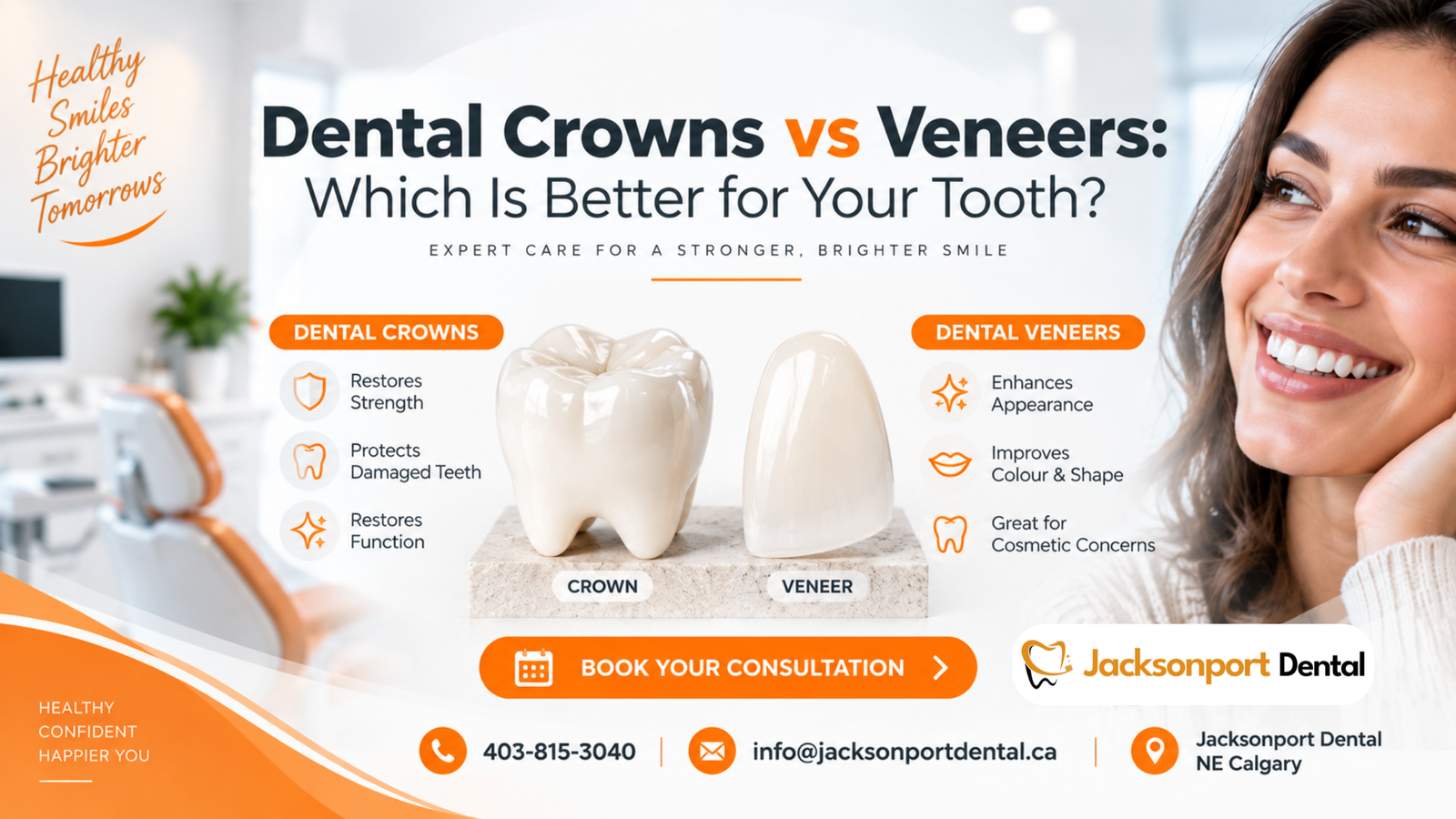
A dental crown covers most or all of the visible portion of a tooth to restore its strength, shape, function, and appearance. A veneer is a thin, tooth-coloured covering placed mainly over the front surface of a tooth to improve its appearance.
In simple terms:
- Crowns: Primarily restore and protect damaged or weakened teeth.
- Veneers: Primarily improve the appearance of otherwise reasonably healthy teeth.
The American Dental Association explains that veneers cover the front surface rather than the entire tooth, while crowns can strengthen weak teeth and restore teeth that are already broken.
What Is a Dental Crown?
A dental crown—sometimes called a “cap”—is a custom restoration placed over a tooth.
A dentist may recommend a crown when a tooth has lost enough structure that a smaller restoration may not provide adequate protection.
Crowns may be considered for teeth that are:
- Cracked or significantly weakened
- Badly worn or broken
- Heavily filled
- Severely discoloured or misshapen
- Restored after certain root canal treatments
- Part of a dental bridge
- Being restored over a dental implant
Crowns can therefore provide both tooth restoration and cosmetic improvement. The ADA notes that crowns can strengthen teeth with large fillings, protect weak teeth from breaking, and restore teeth that have already broken.
Learn more about crowns, bridges and veneers at Jacksonport Dental.
What Are Dental Veneers?
Dental veneers are thin, custom-made coverings bonded to the front surfaces of teeth.
Their main purpose is cosmetic. They can change the visible colour, shape, proportion, and overall appearance of a tooth while leaving more of the tooth uncovered than a full crown.
Veneers may be considered for:
- Chipped front teeth
- Stubborn discolouration
- Minor gaps
- Misshapen teeth
- Uneven-looking teeth
- Cosmetic smile improvements
Common options include porcelain and composite veneers. Porcelain veneers are designed to provide a strong, natural-looking result, while composite veneers may require less enamel removal and can be easier to repair if damaged.
It’s important to remember that veneers are not simply something placed over an unhealthy tooth. Existing decay or gum disease should be addressed before veneer treatment.
Veneers vs Crowns: Key Differences
| Factor | Dental Crown | Dental Veneer |
|---|---|---|
| Coverage | Covers most or all of the visible tooth | Mainly covers the front surface |
| Main goal | Restore strength and function | Improve appearance |
| Best suited for | Damaged or weakened teeth | Generally healthy teeth with cosmetic concerns |
| Tooth preparation | Usually more extensive | Generally more conservative |
| Cosmetic improvement | Yes | Yes |
| Can strengthen a compromised tooth | Often | Limited |
| Common location | Front or back teeth | Primarily visible/front teeth |
Neither treatment automatically wins the veneers vs crowns comparison. The condition of the tooth should guide the decision.
When Is a Crown Better Than a Veneer?
Imagine a front tooth with a small cosmetic imperfection. Covering the entire tooth may be unnecessary.
Now imagine a tooth with a large filling and significant structural damage. Improving only its front surface may not address the underlying weakness.
A dental crown may be more appropriate when the tooth requires structural protection in addition to cosmetic improvement.
For example, your dentist may discuss a crown when there is substantial tooth damage, a large existing restoration, or a significant fracture.
Patients interested in this type of tooth restoration can also read our guide to dental crowns vs veneers.
When Are Veneers the Better Choice?
Veneers may make more sense when the tooth is generally healthy but its appearance is the primary concern.
For example, you might dislike:
- The colour of a front tooth
- A small chip
- An irregular shape
- Minor spacing
- The proportions of visible teeth
In these situations, dental veneers can provide a cosmetic change without covering the entire tooth.
However, veneers still typically require some enamel removal, and treatment is generally not considered reversible because enamel is removed during preparation.
What About Cosmetic Crowns?
The term cosmetic crowns generally refers to crowns used where appearance is an important part of the restoration.
Modern tooth-coloured crowns can be designed to complement surrounding teeth in colour and shape. This can be especially useful when a visible tooth needs both structural restoration and aesthetic improvement.
If your teeth are healthy and your goal is primarily cosmetic, however, your dentist may discuss alternatives such as veneers, dental bonding, orthodontic treatment, or teeth whitening, depending on the concern.
How Does a Dentist Decide Between Crowns and Veneers?
There isn’t a one-size-fits-all answer.
Before recommending treatment, a dentist may evaluate:
- How much healthy tooth structure remains
- Whether decay or cracks are present
- Existing fillings or restorations
- Your bite and chewing forces
- Teeth grinding or clenching
- Gum health
- Tooth colour and shape
- Your cosmetic expectations
This is why an examination matters. What appears to be a purely cosmetic issue can sometimes involve structural problems that aren’t obvious when you look in the mirror.
A comprehensive dental exam can help determine which options may be appropriate for your tooth.
Dental Crowns vs Veneers in Calgary: Which Should You Choose?
If you’re deciding between dental crowns vs veneers in Calgary, start with the health of the tooth rather than the appearance you want to achieve.
Choose based on the problem:
- Mostly cosmetic concern + generally healthy tooth: A veneer may be considered.
- Weakened, extensively restored, or significantly damaged tooth: A crown may provide the protection it needs.
That decision should ultimately be made after your dentist examines the tooth and discusses the benefits, limitations, and alternatives with you.
FAQs About Dental Crowns and Veneers
Are veneers better than crowns?
Not necessarily. Veneers are often better suited to cosmetic changes on otherwise healthy teeth, while crowns can provide greater coverage and protection for structurally compromised teeth.
Do crowns last longer than veneers?
Both can provide years of service, but longevity varies considerably depending on the material, bite forces, oral hygiene, tooth condition, grinding habits, and other factors.
Do veneers damage your natural teeth?
Veneer treatment generally involves removing some enamel, so it should be considered carefully. Because enamel is removed during preparation, veneer treatment is generally not reversible.
Can a veneer fix a badly broken tooth?
A veneer may improve minor chips, but a significantly damaged tooth may require a more protective restoration. Your dentist needs to assess how much healthy tooth structure remains.
Can crowns and veneers look natural?
Yes. Both can be designed to complement the colour and shape of surrounding teeth. The final result depends on the tooth, material, treatment planning, and individual clinical situation.
Find the Right Restoration for Your Smile
Choosing between crowns and veneers isn’t simply a cosmetic decision. The goal is to find a solution that looks natural while protecting the long-term health and function of your tooth.
If you’re considering dental crowns or veneers in NE Calgary, Jacksonport Dental serves patients from Cityscape, Cornerstone, Skyview Ranch, Savanna, and surrounding communities.
Request an appointment to discuss which option may be appropriate for your smile.